Online dialogue on Knowledge gaps and Needs
Organised by the IPBES
09 December 2025, 13:00-15:30 CET | online
We are pleased to invite all IPBES members, observers, and stakeholders to the Online dialogue meeting with research funders and programmers and other relevant funding organizations on knowledge gaps identified in the Nexus and Transformative Change Assessments, and general knowledge needs of future assessments. During the dialogue meeting, the knowledge and data gaps identified in the Nexus and Transformative Change Assessments will be presented by assessment experts with a view to catalysing efforts and initiatives aimed at addressing these gaps.
The meeting will also provide a brief overview of the timeline and process of the Spatial Planning and Connectivity assessment (to be finalized in 2027) and of the Second Global assessment (to be finalized in 2028). An overview of the general knowledge needs for these assessments will also be presented, which may catalyse short-term knowledge generation initiatives with the aim of making information available that will be relevant to the assessments. It also aims to provide a space to share experiences on how to best build on identified knowledge gaps in completed IPBES assessments and catalyse generation of new knowledge.
The agenda is available on the IPBES website
The dialogue will be conducted in English. Participants are invited to register for the webinar, using this link, as soon as possible but no later than 8 December 2025.
For any questions concerning the dialogue, please contact the technical support unit for knowledge generation catalysis at: tsu.knowledgeneration@ecologie.gouv.fr.
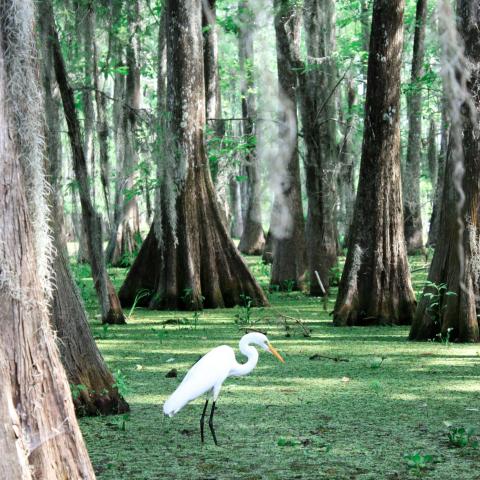
Photo by Morgane Perraud on Unsplash: Great Egret (Ardea alba) standing among towering bald cypress trees in the wetlands of Lake Martin, Louisiana. This rich swamp ecosystem supports diverse wildlife, stores carbon, and plays a vital role in regional water regulation and habitat conservation.